NOTICE

Showing posts with label Daily News Analysis. Show all posts

Everyone should know about COVID-19 vaccine booster shots...Researchers are working on questions of immunity and how to deal with viral variants...

July 06, 2021


Roughly six months ago, on December 11, the Food and Drug Administration authorized the first COVID-19 vaccine for emergency use in the United States. What followed was a push to get that shot, developed by Pfizer and BioNTech, to those at high risk (SN: 12/1/20). Moderna’s jab wasn’t far behind, securing emergency use authorization just a week after Pfizer’s (SN: 12/17/20; SN: 12/11/20). And then in February 2021, there were three COVID-19 vaccines when the FDA authorized Johnson & Johnson’s shot (SN: 2/27/21). 

Now, around 40 percent of the U.S. population is fully vaccinated. Just over half of residents have gotten at least one dose. Meanwhile, U.S. cases of COVID-19 and deaths have plunged to their lowest levels since March 2020.  

Amid the ongoing effort to vaccinate people, two big questions loom: Will immune protection against the coronavirus be long-lived? Or will people soon need booster shots?

Right now, “no one knows” if boosters will be necessary, says Kirsten Lyke, a vaccinologist at the University of Maryland School of Medicine in Baltimore. But researchers are working on figuring that out.

Here’s what we know so far about coronavirus immunity and potential booster shots. 

Immunity lasts at least six months and possibly much longer.

Whether people need COVID-19 booster shots or not largely hinges on how long the body’s immune response protects against getting severely ill. So far, this protection lasts at least six months and possibly much longer, researchers say.

Much of what scientists know right now about long-term immunity comes from what they have gleaned from people infected with the coronavirus. And it appears that immune memory to the virus largely follows the rules, at least for most people, says Ali Ellebedy, an immunologist at Washington University School of Medicine in St. Louis.

That means that after the virus gains a foothold, the body unleashes a wave of immune proteins called antibodies and immune cells dubbed T cells to fight off the virus. Antibodies typically attack the virus itself while T cells raise additional alarm bells or kill infected cells. Together, antibodies and T cells defeat the virus and then help the immune system form a memory of the pathogen, Ellebedy says. That immune memory is crucial for protection if a person gets exposed to the virus again.

Studies are uncovering evidence that most people develop immune memory to the coronavirus. Ellebedy has found signs of antibody memory, for instance, in people who recovered from an infection. People who had mild COVID-19 had long-lived antibody-producing immune cells in the bone marrow 11 months after infection, he and colleagues reported May 24 in Nature. These cells continue to make antibodies against the virus long after it has left the body, providing protection if a person is exposed again.

Evidence is building that the vaccines offer similar, if not better, protection. In that case, boosters might not be needed for some time. In the last update from vaccine developers, “things looked pretty good,” Lyke says. People who received Moderna’s shot still have high levels of antibodies six months after getting the second dose, researchers reported in April. And Pfizer’s jab has an efficacy of 91.3 percent against COVID-19 symptoms after six months, the pharmaceutical company announced April 1 in a news release.  

Still, “we don’t know how any of these COVID-19 vaccines perform past the one-year mark,” Lyke says. The earliest trials that tested whether the vaccines prompt an immune response are just now reaching that point, and researchers are following up with participants (SN: 7/21/20).

Coronavirus variants could make booster shots more likely.

Even if the protection provided by the immune system is long-lasting, viruses like the coronavirus are adept at evading those responses. Case in point: the emergence of viral variants that can make COVID-19 vaccines less effective than they are against the original version of the virus (SN: 5/11/21).

“I don’t think we would be talking about potentially boosting” if it weren’t for the variants, Ellebedy says. “What we are seeing so far is that the vaccine is really robust, so why would we even need a booster if the virus doesn’t change?”

Available vaccines still protect people from the worst of COVID-19, even if they’re infected by one of the circulating variants. But that might not always be the case. “There may be a future variant that we’re unaware of that may come down and surprise us,” Lyke says. Still, multiple COVID-19 vaccines are flexible in design and can easily be adapted to tackle new variants (SN: 1/27/21). Then, it becomes a matter of manufacturing the doses.   

Some companies, including Pfizer and Moderna, are already testing booster shots to fight emerging variants, in particular, the beta variant that first emerged in South Africa. Early results from Moderna hint that people who received a booster shot that uses the version of a viral protein from the beta variant had antibodies that were better at stopping the variant from infecting cells compared with people who got a third dose of the original vaccine.  

Still, one question is what the best variant booster might look like, says Jerome Kim, a vaccinologist and director-general of the International Vaccine Institute in Seoul, South Korea. Researchers around the globe meticulously monitor circulating influenza strains, for example, to figure out which strain or strains should be included in flu vaccines. In the future, experts may need to keep an eye on the coronavirus in a similar way.

Low vaccination rates worldwide may also make booster shots more likely.

As countries like the United States begin to emerge from the worst of the pandemic, there are many others lagging behind in vaccinations (SN: 2/26/21). That’s in part because wealthy countries have bought the bulk of available doses to vaccinate their populations, leaving lower-income countries struggling to get shots.   

To date, more than 2 billion doses have made it into arms around the world. Some countries, including Canada, the United Kingdom, Chile and Israel, have given at least one dose to around 60 percent of their populations. But around only 1 percent of people in places like Nigeria and Sierra Leone have gotten at least one vaccine dose.

Low vaccination rates in many places pose a problem for efforts to quell transmission and bring the pandemic to an end. And the more the coronavirus spreads, the more opportunities there will be for new variants to emerge, increasing the likelihood of booster shots. The coronavirus “has managed to find the gaps, like any virus,” Kim says. “It’s in the nature of viruses to find the weak points. And before you know it, there’s another mutant.”

Some countries are flying blind due to a lack of genetic surveillance. Bolstering that ability in regions like Africa, Latin America and South Asia would help get a handle on coronavirus diversity in those places and capture emerging variants before they become a global problem.   

It’s also important to get vaccines to the places that need them through efforts like COVAX, an international initiative to help distribute COVID-19 to low-income countries. “We have to start going to the places that have really bad outbreaks because we know mutants will be generated,” Kim says.

“Mix-and-match” COVID boosters might offer even more protection.

To prepare for a future where people need COVID-19 boosters, the U.S. National Institute of Allergy and Infectious Diseases launched a clinical trial on June 1 to test mixing and matching COVID-19 vaccines.

The big question is whether mix-and-match vaccines strengthen the immune response against the coronavirus, says Lyke, one of the researchers leading the trial. If someone is given an mRNA vaccine, like Moderna or Pfizer’s, and then is given a Johnson & Johnson booster, “can we increase [the immune response] by switching up the platform?” Lyke says.

Mixing different types of Ebola vaccines or HIV vaccines, for example, can trigger stronger immune responses than getting multiple doses of the same vaccine (SN: 6/4/21). The idea is that each shot will activate multiple parts of the immune system, Lyke says. An mRNA vaccine might prompt the body to make lots of antibodies that attack the virus. Then a dose of a vaccine like Johnson & Johnson’s — which uses a common cold virus that has been modified so it can’t cause disease — might trigger more T cells. “If you combine [the shots], we hope to prove that you get the best of both responses that work synergistically,” Lyke says.

Early results from a similar trial being conducted in the United Kingdom hint that the answer for COVID-19 shots is yes. People given AstraZeneca’s COVID-19 shot followed by a dose of Pfizer’s eight weeks later developed potent immune responses, researchers reported in a preliminary study posted June 1 at medRxiv.org. Antibodies from people who received the two different vaccines were better at recognizing variants like beta compared with those in people who got two doses of Pfizer’s vaccine.

A separate study in Spain also found that people given a dose of AstraZeneca’s COVID-19 shot followed by a dose of Pfizer’s had high levels of antibodies compared with people who got only one dose of AstraZeneca’s vaccine, researchers reported in May. But it’s unclear how those levels compare with people who got two doses of the same shot.   

One benefit of the U.S. trial is that it has a flexible design, Lyke says. That means that if new variants arise, researchers can add new groups to the trial to test newly developed boosters. “As we get data [about variants] that comes in from other countries, we can really start to hone in on holes in our data and what we need to answer.”   

Scientists have found the origins of a mysterious, deadly flood in India...A massive landslide of rock and ice caused the February flood that left over 200 people dead or missing;

June 14, 2021


On February 7, a massive flood rushed through a valley in India’s Himalayan Uttarakhand state, washing out two hydroelectric power plants and leaving at least 200 people dead or missing. What triggered the deadly flood has been a mystery — but after amassing evidence from satellite images, seismic records and eyewitness accounts, a team of over 50 scientists now say they have solved the case.

The ultimate culprit was a massive avalanche of rock and glacier ice that tumbled 1,800 meters down a steep slope of Ronti Peak, setting off a cascade of events that led to the disaster, the researchers report online June 10 in Science.

This was no ordinary landslide, says Daniel Shugar, a geomorphologist at the University of Calgary in Canada. “This was a multi-hazard scenario where it was much more fluid and mobile than a landslide would be expected to be. It was a worst-case scenario of rock and ice and [the] height of the fall.”

This animation shows the progress of the avalanche, as it rushes downslope toward the two hydroelectric dams at Tapovan. Colors show which material was dominant in the avalanche as it flowed. At the start, where the avalanche is colored red, it was mostly (about 80 percent) rock and 20 percent ice. Green is mostly ice, as the rocks begin to splash or settle out. By the time the flow reached Tapovan, it had become mostly water (blue).

Initially, the culprit was suspected to be a well-known high mountain hazard called a glacial lake outburst flood, in which dammed-up water suddenly spills over its bounds and rushes down the mountainside (SN: 2/9/21). But what little data were available in the immediate aftermath pointed to a possible landslide instead, Shugar says.

In the months that followed, he and his colleagues used numerous sources of data as well as computer simulations to painstakingly reconstruct what happened that day.

Here’s what the data show:

Starting around 10:21 a.m. local time on February 7, about 27 million cubic meters of rock and ice fell from the steep north face of Ronti Peak, which stands 6,063 meters above sea level. The landslide, consisting of about 80 percent rock and 20 percent ice, originated at a height of about 5,500 meters and tumbled downslope about 1,800 meters, traveling at a speed of up to 60 meters per second.

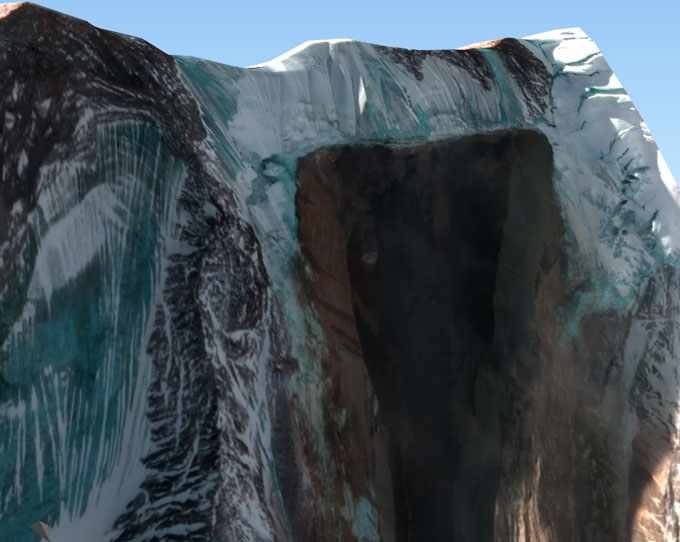
photo of the side of a mountain
On February 9, two days after the disastrous flood, France’s PlĂ©iades satellites snapped this high-resolution image of Ronti Peak, showing a scar on the steep north face of the mountain spanning 500 meters. That scar, a new feature, marks the origin of the avalanche of rock and ice that caused the flood. Using stereo images from these satellites, researchers also constructed high-resolution 3-D models of the site, which allowed them to estimate the volume of the avalanche.

Digital elevation models now reveal a rock scar on the slope that wasn’t there previously. Earlier images of the site suggest that a very long and wide fracture in the overhanging glacier had opened up by 2018.

As the landslide then rushed down the Ronti Gad stream valley, wet material splashed up the valley’s sides, depositing sediment and large boulders on the valley walls. Satellite images also captured thick blankets of airborne dust — the first indicators that a landslide might be the culprit.

As the landslide continued downhill, the ice began to melt due to the friction, helping to speed it along. Then, the landslide encountered a sharp bend in the valley, and much of the solid material dropped out, shifting it from a thick, viscous flow to a faster-moving, more fluid flow. These rushing waters were now on their way to the two hydroelectric power plants in their path downstream. Eyewitness accounts saw only this part of the flood.  

On February 7, the day of the disaster, a constellation of miniature cube satellites belonging to private imaging company Planet Labs snapped these images of vast dust deposits scattered across the valley below Ronti Peak but above the hydroelectric dams. These images were among the first clues that a landslide, rather than a glacial lake outburst flood, was responsible for the disaster.

There are no easy answers for whether or how people can prepare for such a disaster — but the first step is a better understanding of possible causes, Shugar says. That’s where he hopes that this study can help. “We need to be doing a better job of hazard assessments, and not examining hazards in singularity.”

As for what role climate change may have played, it’s also difficult to say. There are no weather stations close to the site of the original slope failure that could provide temperature or precipitation measurements to assess changing climate in that region. But “we can say that climate change is increasing the severity and frequency of natural disasters,” by thinning glaciers and their underpinnings, Shugar says.

And it’s also clear that increasing development in the mountains compounds the likelihood of disaster, adding to the urgency of understanding the possible dangers, he notes. “If the mountains themselves are becoming more hazardous, and we’re also pushing farther into those mountains, that becomes a dangerous mix.”

Climate change behind one in three heat-related deaths globally...

June 06, 2021


Human-induced is responsible for over a third of all deaths in which heat played a role in the last three decades, according to a study.

The research, published on Monday in the journal Nature Climate Change, used data from 732 locations in 43 countries, showing for the first time the actual contribution of human-made in increasing mortality risks due to heat.

The researchers at the London School of Hygiene & Tropical Medicine (LSHTM), UK, and the University of Bern in Switzerland found that 37 per cent of all heat-related deaths in the recent summer periods were attributable to the warming of the planet due to human-caused activities.

This percentage of heat-related deaths attributed to human-induced was highest in Central and South America -- up to 76 per cent in Ecuador or Colombia, for example -- and South-East Asia, between 48 per cent and 61 per cent.

The findings are further evidence of the need to adopt strong mitigation policies to reduce future warming, and to implement interventions to protect populations from the adverse consequences of heat exposure, the researchers said.

"We expect the proportion of heat-related deaths to continue to grow if we don't do something about or adapt," said first author of the study, Ana M. Vicedo-Cabrera, from the University of Bern.

"So far, the average global temperature has only increased by about 1 degree Celsius, which is a fraction of what we could face if emissions continue to grow unchecked," Cabrera said.

The study examined past weather conditions simulated under scenarios with and without anthropogenic or human-caused emissions.

This enabled the researchers to separate the warming and related health impact linked with human activities from natural trends.

Heat-related mortality was defined as the number of deaths attributed to heat, occurring at exposures higher than the optimum temperature for human health, which varies across locations.

While on average over a third of heat-related deaths are due to human-induced climate change, impact varies substantially across regions, according to the researchers.

Climate-related heat casualties range from a few dozen to several hundred deaths each year per city, depending on the local changes in climate in each area and the vulnerability of its population, they said.

The researchers noted that populations living in low and middle-income countries, which were responsible for a minor part of anthropogenic emissions in the past, are those most affected.

"This is the largest detection & attribution study on current health risks of climate change," said senior author of the study, Antonio Gasparrini, Professor at LSHTM.

"Climate change will not just have devastating impacts in the future, but every continent is already experiencing the dire consequences of human activities on our planet. We must act now," Gasparrini added.

The researchers acknowledge some limitations of the study, such as their inability to include locations in all world regions, for example, large parts of Africa and South Asia, due to a lack of empirical data.

Playing brain training games regularly doesn’t boost brainpower...

May 31, 2021


Even among dedicated trainers, the games didn’t boost brainpower in a large, real-world test...


It’s an attractive idea: By playing online problem-solving, matching and other games for a few minutes a day, people can improve such mental abilities as reasoning, verbal skills and memory. But whether these games deliver on those promises is up for debate.

“For every study that finds some evidence, there’s an equal number of papers that find no evidence,” says Bobby Stojanoski, a cognitive neuroscientist at Western University in Ontario (SN: 3/8/17SN: 5/9/17).

Now, in perhaps the biggest real-world test of these programs, Stojanoski and colleagues pitted more than 1,000 people who regularly use brain trainers against around 7,500 people who don’t do the mini brain workouts. There was little difference between how both groups performed on a series of tests of their thinking abilities, suggesting that brain training doesn’t live up to its name, the scientists report in the April Journal of Experimental Psychology: General.

“They put brain training to the test,” says Elizabeth Stine-Morrow, a cognitive aging scientist at the University of Illinois at Urbana-Champaign. While the study doesn’t show why brain trainers aren’t seeing benefits, it does show there is no link “between the amount of time spent with the brain training programs and cognition,” Stine-Morrow says. “That was pretty coo

The researchers recruited 8,563 volunteers globally through Cambridge Brain Sciences, a Toronto-based company that provides assessments to measure healthy brain function. (While several of the researchers are affiliated with the company, it didn’t receive funding for the study.) Participants filled out an online questionnaire about their training habits, opinions about training benefits and which, if any, program they used. Some 1,009 participants reported using brain training programs for about eight months, on average, though durations ranged from two weeks to more than five years.

Next, the volunteers completed 12 cognitive tests assessing memory, reasoning and verbal skills. They faced Simon-like memory exercises, such spatial reasoning tasks as mentally rotating objects, pattern-finding puzzles and strategy challenges. 

When researchers looked at the results, they saw that brain trainers on average had no mental edge over the other group in memory, verbal skills and reasoning. Even among the most dedicated, who had used training programs for at least 18 months, brain training didn’t boost thinking abilities above the level of people who didn’t use the programs.

That’s not because brain trainers have poorer function to start with and then improved. Participants who had trained for less than a month, and presumably wouldn’t have reaped significant benefits from the programs yet, performed on par with people who didn’t train at all.

“No matter how we sliced the data, we were unable to find any evidence that brain training was associated with cognitive abilities,” says Stojanoski. That held true whether the team analyzed participants by age, program used, education or socioeconomic status – all were cognitively similar to the group who didn’t use the programs.

Brain training may be beneficial in specific scenarios, Stojanoski says. But “part of our goal was to look at brain training in the real world.”  

That real world may be the best brain trainer, Stine-Morrow says. While it’s possible to improve mental abilities, Stine-Morrow advocates practicing those skills in different real-life situations. “That’s a much better use of one’s time than sitting at a computer and doing little tasks.”

 
Copyright © iDream Management & Nursing College. , Developed With Love By iDream Management College Students