
NOTICE

Showing posts with label Health. Show all posts

Surgical Face Masks Provide Good Protection Against Aerosols – Plastic Face Shields Provide No Protection


Face Shield and Surgical Mask

New research presented at this year’s European Congress of Clinical Microbiology & Infectious Diseases (ECCMID), held online this year (9-12 June), shows that wearing a surgical face mask can provide similar protection against aerosols as wearing a respirator. Face shields, however, provide little or no protection.

The efficacy of personal protective equipment (PPE), including face masks, has been the focus of scientific and public interest since emergence of the SARS-CoV-2, a virus which is mainly transmitted through droplets and aerosols in poorly ventilated settings. It is crucial to provide healthcare workers with high quality face masks or respirators to protect both themselves and their patients. However, at start of the pandemic, some experts, particularly in Europe, said that while surgical face masks protect others, they provide no significant protection for the wearer. Moreover, many newly produced masks seem to be of poor quality.

The study, by Dr. Christian Sterr and colleagues at Philipps University Marburg, Marburg, Germany, compared 32 types of mask intended for use in hospitals, including cloth and surgical (medical) masks, respirators, and face shields. The surgical masks included some with EN 14683 certification (the EU quality standard) and others that were non-certified. Both FFP2 and KN95 respirators were tested. KN95 respirators, which meet Chinese standards, were subject to EU RAPEX safety warnings from April 2020.

The first experiment measured the filtration efficacy of the mask material. Each mask was fixed to an air-collecting tube inside an airtight tank. An aerosol of the chemical di-ethyl-hexyl-sebacat (DEHS) was pumped into the tank and the aerosol particles in the collecting tube counted by a particle counter.

The average filtration efficacy was lowest for the cloth masks (28%), followed by the non-certified surgical masks (63%) and the certified surgical masks (70%). The KN95 respirator material filtered out 94% of particles and the FFP2 mask material, 98%.

The second experiment measured the air pressure on either side of the mask. Surgical face masks produced the lowest drop in pressure and so would provide the least resistance to breathing — type II surgical masks produced a pressure drop of 12.9 Pa/cm², while non-certified surgical masks produced a pressure drop of 16.2 Pa/cm².

Respirators produced pressure drops that were two to three times higher (26.8 Pa/cm² for FFP2 and 32.3 Pa/cm² for KN95). The results for the cloth masks ranged between 6.9 and 149.3 Pa/cm².

The third experiment measured the filtration efficacy of the masks as worn. It used a similar set-up to the first experiment but the masks were mounted on a dummy head with an artificial trachea or windpipe, instead of being fixed to the air-collecting tube. The artificial head was the size of the average person in the US and had a skin-like coating, to provide a more realistic mask fit.

The cloth masks and the non-certified surgical masks had the worst as-worn filtration efficacies, filtering out just 11.3% and 14.2% of the particles, respectively. Remarkably, the type II surgical face masks had similar as-worn filtration results (47%) to the KN95 respirators (41%) and FFP2 respirators (65%). The face shields did not have any significant effect.

Experiments 1 and 3 focused on particles of 0.5 μm — a size judged to be realistic for SARS-CoV-2 particles, which cluster together.

The study’s authors say that for a combination of optimum benefit and ease of breathing, a mask should combine good filtration with a low drop in pressure. They add: “In our tests, these parameters were achieved by the majority of FFP2 and surgical type II face masks.

“EN 14683 type II certified surgical face masks, in particular, can provide high protection with low airflow resistance at the same time. Non-certified cloth and surgical face masks provided very poor protection against our test aerosol. The cloth masks showed high variability between different mask types.

“Not surprisingly, FFP2 respirators provided the best protective effect on an average. KN95 respirators performed relatively poorly, with filtration efficacies ranging from 36% to 47%. These results are inferior to those of the best surgical type II face masks, whose performances ranged from 13% to 66%. The results are remarkable given the higher price, better subjective feeling of protection and higher air flow resistance of the KN95 respirators. However, our findings are consistent with the RAPEX warnings.”

Surgical face masks also produce less resistance to breathing and so are more comfortable to wear, says Dr. Sterr.

He adds: “In our tests, respirators had two to three-fold higher airflow resistances than surgical face masks. This might lead to lower user adherence and, consequently, to a lower overall protection rate. Therefore, it seems reasonable to widely use surgical face masks in hospitals to prevent the virus from spreading, especially if distancing and quarantining are not possible.

“In situations where a patient cannot wear a mask (e.g. intubation), a surgical face mask does not seem sufficient to protect the healthcare worker from SARS-CoV-2. In such cases, respirators such as FFP2 masks should be considered. KN95 respirators should be worn only if other respirators are not available. Face shields should only be used to keep masks and respirators dry when undertaking procedures in which there is a risk of splashes.

“Members of the public should wear certified surgical face masks of good quality, rather than cloth masks or face shields, which performed poorly in our study, or respirators, which should be reserved for medical staff.”

The Southern Diet – Fried Foods and Sugary Drinks – May Increase Risk of Sudden Cardiac Death

June 30, 2021


Fried Chicken and Waffles

  • Participants in a large-scale study who more commonly consumed a Southern-style diet – high in added fats, fried foods, processed meats and sugary drinks – had a higher risk of sudden cardiac death than people who had lower adherence to a Southern-style diet.
  • However, participants who closely followed a Mediterranean diet, which is high in vegetables, fruits, fish, whole grains and legumes while being low in meat and dairy, had a lower risk of sudden cardiac death than people who tended not to follow the Mediterranean style diet.

Regularly eating a Southern-style diet may increase the risk of sudden cardiac death, while routinely consuming a Mediterranean diet may reduce that risk, according to new research published today (June 30, 2021) in the Journal of the American Heart Association, an open access journal of the American Heart Association.

The Southern diet is characterized by added fats, fried foods, eggs, organ meats (such as liver or giblets), processed meats (such as deli meat, bacon and hotdogs) and sugar-sweetened beverages. The Mediterranean diet is high in fruits, vegetables, fish, whole grains and legumes and low in meat and dairy.

“While this study was observational in nature, the results suggest that diet may be a modifiable risk factor for sudden cardiac death, and, therefore, diet is a risk factor that we have some control over,” said James M. Shikany, Dr.P.H., F.A.H.A., the study’s lead author and professor of medicine and associate director for research in the Division of Preventive Medicine at the University of Alabama at Birmingham.

“Improving one’s diet – by eating a diet abundant in fruits, vegetables, whole grains and fish such as the Mediterranean diet and low in fried foods, organ meats and processed meats, characteristics of the Southern-style dietary pattern, may decrease one’s risk for sudden cardiac death,” he said.

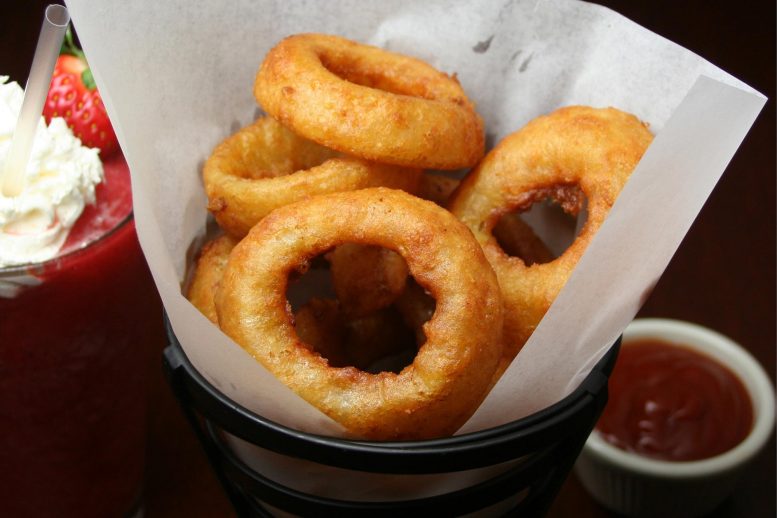
Fried Onion Rings

The study examined data from more than 21,000 people ages 45 and older enrolled in an ongoing national research project called REasons for Geographic and Racial Differences in Stroke (REGARDS), which is examining geographic and racial differences in stroke. Participants were recruited between 2003 and 2007. Of the participants in this analysis, 56% were women; 33% were Black adults; and 56% lived in the southeastern U.S., which is noteworthy as a region recognized as the Stroke Belt because of its higher stroke death rate. The Stroke Belt states included in this study were North Carolina, South Carolina, Georgia, Tennessee, Alabama, Mississippi, Arkansas, and Louisiana.

This study is the latest research to investigate the association between cardiovascular disease and diet – which foods have a positive vs. negative impact on cardiovascular disease risk. It may be the only study to-date to examine the association between dietary patterns with the risk of sudden cardiac death, which is the abrupt loss of heart function that leads to death within an hour of symptom onset. Sudden cardiac death is a common cause of death and accounted for 1 in every 7.5 deaths in the United States in 2016, or nearly 367,000 deaths, according to 2019 American Heart Association statistics.

Researchers included participants with and without a history of coronary heart disease at the beginning of the study and assessed diets through a food frequency questionnaire completed at the beginning of the study. Participants were asked how often and in what quantities they had consumed 110 different food items in the previous year.

Researchers calculated a Mediterranean diet score based on specific food groups considered beneficial or detrimental to health. They also derived five dietary patterns. Along with the Southern-style eating pattern, the analysis included a “sweets” dietary pattern, which features foods with added sugars, such as desserts, chocolate, candy and sweetened breakfast foods; a “convenience” eating pattern which relied on easy-to-make foods like mixed dishes, pasta dishes, or items likely to be ordered as take-out such as pizza, Mexican food and Chinese food; a “plant-based” dietary pattern was classified as being high in vegetables, fruits, fruit juices, cereal, bean, fish, poultry and yogurt; and an “alcohol and salad” dietary pattern, which was highly reliant on beer, wine, liquor along with green leafy vegetables, tomatoes and salad dressing.

Shikany noted that the patterns are not mutually exclusive. “All participants had some level of adherence to each pattern, but usually adhered more to some patterns and less to others,” he explained. “For example, it would not be unusual for an individual who adheres highly to the Southern pattern to also adhere to the plant-based pattern, but to a much lower degree.”

After an average of nearly 10 years of follow-up every six months to check for cardiovascular disease events, more than 400 sudden cardiac deaths had occurred among the 21,000 study participants.

The study found:

  • Overall, participants who ate a Southern-style diet most regularly had a 46% higher risk of sudden cardiac death than people who had the least adherence to this dietary pattern.
  • Also, participants who most closely followed the traditional Mediterranean diet had a 26% lower risk of sudden cardiac death than those with the least adherence to this eating style.


Copyright © iDream Management & Nursing College. , Developed With Love By iDream Management College Students